Major Research Activities
Transport and turbulence at the tokamak edge
Origin and evolution/propagation of coherent convective structures
Ambient fluctuation characteristics at the tokamak edge
Formation of plasma current from the ECR slab plasma in tokamaks
Poloidal and toroidal plasma rotation
Visible Imaging and Tomographic Reconstruction of Tangential Images of the Tokamak Plasma
A tangentially viewing fast camera can provide images of the evolving plasma with appreciable temporal and spatial resolution
With the assumption of toroidal symmetry, these cameras have sufficient viewing chords for tomographic reconstruction, essentially inferring the poloidal emissivity. This might provide valuable information about the shape of the flux surfaces, disturbances due to both field errors and MHD activities and edge turbulence. A tomographic reconstruction code had been developed for inferring the poloidal emissivity of tokamak plasma from tangentially acquired images. In a tokamak it is very likely that the illumination on the camera pixels would also be receiving contributions from the light scattered from the vessel wall. Here an attempt is made to account for the reflected light in the reconstruction in a tractable manner
A novel method to calibrate the Line of sight of the camera w.r.t the co-ordinate system (vessel center as origin) has been developed and implemented for tangential images of Aditya plasma. Finally, initial attempts are made to reconstruct the poloidal emissivity profile for tangential images of Aditya capacitor bank discharges.

Tangential View of the camera on Aditya Tokamak
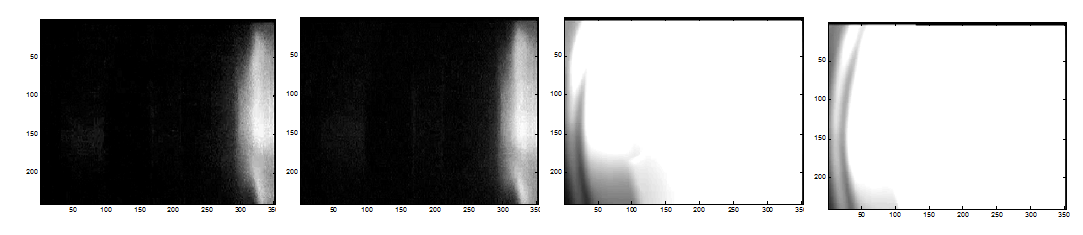
Shot no. 97715: No filter; 4 frames: 2 frames showing ECR pre-ionization; last 2 frames saturated: 20 ms discharge
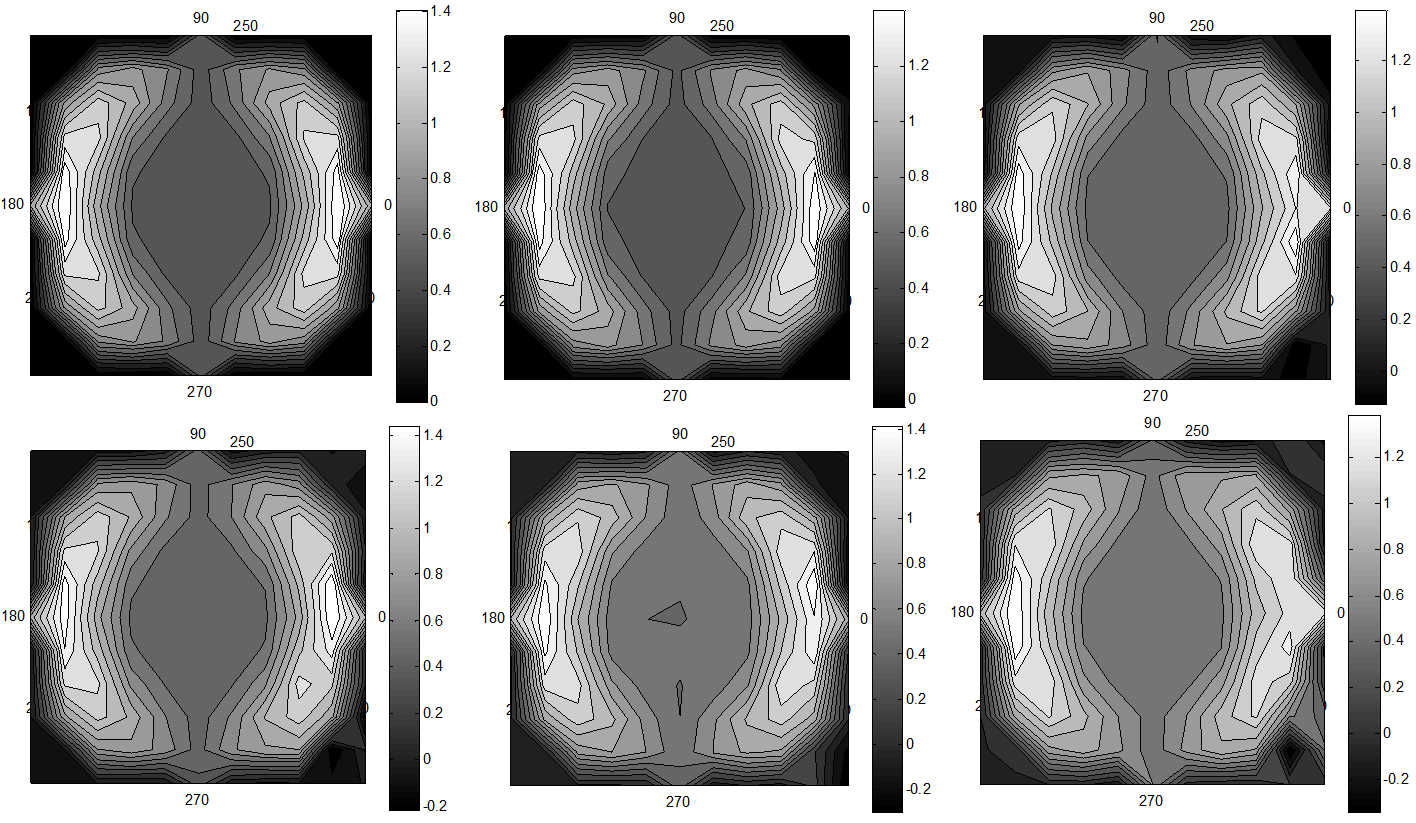
Reconstructed emissivity profiles with increasing amount of shot noise in the input brightness and in the presence of wall reflection. Top row L to R: reconstruction with no noise, 5% noise and 10% noise. Bottom row L to R: reconstruction with 15% noise, 20% noise and 25% noise.

